
31 December 2022


02 January 2022
The Holy Name of Jesus
3 JANUARY 2022. Today the Church, following the Roman calendar currently in effect, celebrates the feast of the Most Holy Name of Jesus.

In a tradition as ancient as the Old Testament, the Name of Our Lord has for millennia been given great respect and devotion. Pray with me that every utterance of the Most Holy Name of Jesus is said as in prayer.
O God,
who founded the salvation of the human race
on the Incarnation of your Word,
give your peoples the mercy which they implore,
so that all may that no other name should be invoked
but the name of Your Only begotten Son.
Who lives and reigns with You
in the unity of the Holy Spirit,
one God, for ever and ever.
Amen.
02 February 2021
Candlemas 2021
2 FEBRUARY 2021. Feast of Candlemas - the Presentation of our Lord Jesus in the Temple.

When the days were completed for their purification according to the law of Moses, they took him up to Jerusalem to present him to the Lord, just as it is written in the law of the Lord, “Every male that opens the womb shall be consecrated to the Lord,” and to offer the sacrifice of “a pair of turtledoves or two young pigeons,” in accordance with the dictate in the law of the Lord.
Now there was a man in Jerusalem whose name was Simeon. This man was righteous and devout, awaiting the consolation of Israel, and the holy Spirit was upon him. It had been revealed to him by the holy Spirit that he should not see death before he had seen the Messiah of the Lord.
He came in the Spirit into the temple; and when the parents brought in the child Jesus to perform the custom of the law in regard to him, he took him into his arms and blessed God, saying:
“Now, Master, you may let your servant go in peace, according to your word, for my eyes have seen your salvation, which you prepared in sight of all the peoples, a light for revelation to the Gentiles, and glory for your people Israel.”
The child’s father and mother were amazed at what was said about him; and Simeon blessed them and said to Mary his mother, “Behold, this child is destined for the fall and rise of many in Israel, and to be a sign that will be contradicted (and you yourself a sword will pierce) so that the thoughts of many hearts may be revealed.”
There was also a prophetess, Anna, the daughter of Phanuel, of the tribe of Asher. She was advanced in years, having lived seven years with her husband after her marriage, and then as a widow until she was eighty-four. She never left the temple, but worshiped night and day with fasting and prayer.
And coming forward at that very time, she gave thanks to God and spoke about the child to all who were awaiting the redemption of Jerusalem.
When they had fulfilled all the prescriptions of the law of the Lord, they returned to Galilee, to their own town of Nazareth.
The child grew and became strong, filled with wisdom; and the favor of God was upon him.

IMAGE: Timothy Radcliffe, O.P., former Master of the Order, at Ely Cathedral, at a celebration of Candlemas.
Credit: Yan Xu, Pinterist
24 January 2021
1900 Roman Martyrology - 24 January
24 JANUARY 2021:
From the 1900 Roman Martyrology - as translated into English.
This Day, the Twenty-Fourth Day of January
The birthday of St. Timothy, disciple of
the Apostle St. Paul, who ordained him bishop of Ephesus. After many
combats for Christ, he was stoned for reprehending those who offered
sacrifices to Diana, and shortly after went peacefully to his rest in
the Lord.
At Antioch, in the persecution of Decius, the
bishop St. Babylas, who frequently glorified God by his sufferings
and torments, and ended his holy life in chains, with which he ordered
his body to be buried. Three boys whom he had instructed in the faith
of Christ, Urbanus, Philidian, Epolonius,
are said to have suffered with him.
At Neocaesarea, the holy martyrs Mardonius, Musonius,
Eugenius, and Metellus, who were burned to death, their remains
being thrown into the river.
At Foligno, in the time of Decius, St. Felician,
consecrated bishop of that city by Pope Victor. After many labors,
he was crowned with martyrdom in extreme old age.
Also, the holy martyrs Thyrsus and Projectus.
At Bologna, St. Zamas, the first
bishop of that city, who was consecrated
by Pope St. Denis, and there wonderfully propagated the Christian faith.
Also, blessed Suranus, abbot, who lived
in the time of the Lombards.
And elsewhere in diverse places, many other holy martyrs, confessors, and holy virgins.
Omnes sancti Mártyres, oráte pro nobis. ("All ye Holy Martyrs, pray for us", from the Litaniae Sanctorum, the Litany of the Saints)
Response: Thanks be to God.08 December 2019
The Immaculate Conception

8 DECEMBER 2019. Although transferred to tomorrow in the United States, today is the date reserved for commemorating the Immaculate Conception of the Blessed Virgin Mary, a dogma of the Church proclaimed by Pope Pius IX, after centuries of consistent belief and teaching that the Blessed Virgin was conceived without sin - set apart from the world to be the Mother of God from the moment of her conception.
Holy Virgin,
as you were conceived without sin
to be the vessel of God in our World,
pray for us,
sinners, that we may always,
faithfully follow your son.
As so great an exemplar for all of us,
we entrust our faith to you, that you
will bring our prayers and needs
before He, who created the world,
but who calls you Mother,
as do we all.
Amen.

Image: Fresco of Pope Pius IX's declaration of the Dogma of the Immaculate Conception
(Francesco Podesti)
06 December 2019
Saint Nicholas
6 DECEMBER 2019. Today the Church celebrates the feast of Saint Nicholas of Myra, a much beloved and historically mysterious 4th Century saint. A wonderful presentation of information, believed to be historically accurate, can be found here: The Life of Saint Nicholas the Wonderworker by Michael the Archimandrite.
 God, Our Father,
we pray that through the intercession of St. Nicholas
You will protect our children.
Keep them safe from harm
and help them grow and become worthy in Your sight.
Give them strength to keep their Faith in You;
and to keep alive their joy in Your creation.
Through Jesus Christ, Our Lord.
Amen
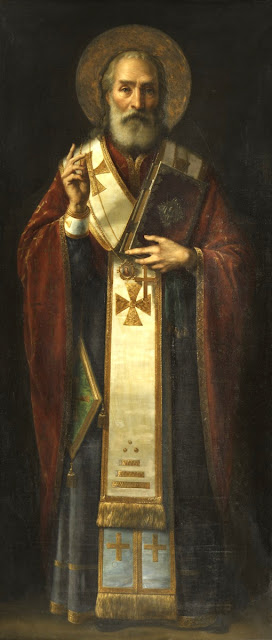

we pray that through the intercession of St. Nicholas
You will protect our children.
Keep them safe from harm
and help them grow and become worthy in Your sight.
Give them strength to keep their Faith in You;
and to keep alive their joy in Your creation.
Through Jesus Christ, Our Lord.
Amen

19 November 2019
Saint Ampelus
20 NOVEMBER 2019. Today the Church celebrates the feast of Saint Ampelus, a third century martyr, who was killed for his faith during the reign of Diocletian.
O, blessed Ampelus, whose martyrdom we recall today,
help us by your prayer, we beseech you,
to face the world today with a spirit of charity,
to stand in the face of untruth, bearing witness to the truth
of Christ, our King.
We pray, that by your example, and intercession,
we may follow you in obedience and love for God.
Aid us, we pray, that we may persevere in holiness,
until death.
Amen.
O, blessed Ampelus, whose martyrdom we recall today,
help us by your prayer, we beseech you,
to face the world today with a spirit of charity,
to stand in the face of untruth, bearing witness to the truth
of Christ, our King.
We pray, that by your example, and intercession,
we may follow you in obedience and love for God.
Aid us, we pray, that we may persevere in holiness,
until death.
Amen.
28 September 2018
et alia
28 SEPTEMBER 2018. Today the Church celebrates the feast of Saint Wenceslaus - the tenth century Duke of Bohemia and martyr for the faith, known far and wide for his humility and pious works on behalf of the poor and needy. Named posthumously as a king, Saint Wenceslaus is yet another reminder that all of us are called to be saints. That is, each of us is called to holiness in our lives, given our state in life, where we seek fully to join ourselves and conform ourselves to the Holy and Divine Will, through our submission to Christ.

Running on at the keyboard:
Much has been made in the U.S. this week of the Brett Kavanaugh hearings before the Senate Judiciary Committee, which is considering his nomination to the Supreme Court. A number of accusations of sexual misconduct and sexual assault have been made against him, and he gave an emotional and pointed rebuke to those accusations and the nomination process yesterday. However, I was disappointed in Judge Kavanaugh. Judicial temperament requires one to maintain a detached view of facts and circumstances to evaluate the application of the law. No judge should be outwardly partisan or emotional, and we saw both from Judge Kavanaugh yesterday in his testimony. To the contrary, a good judge addresses his or her task with humility, emotional neutrality, and somber intellectual inquiry, knowing that decisions can have life-changing consequences for the people impacted. Certainly the Supreme Court's role in our system of government should be able to count on sound judicial temperament from all nine of its justices.
As to sexual assault and all manner of sexual aggression. There is no excuse for these actions. I had a roommate in college who once told me that once he reached a certain point of arousal, there was no way he could stop himself. In his words, he was "animalistic." Not true. We are not animals, and no person should be objectified and victimized for another's sexual gratification or self-satisfaction. As a community of faithful, and as a nation, we should stand in solidarity with those affected by these crimes and ensure that victims are provided for in a manner befitting their dignity.
Dignity of the marriage sacrament, too, must be upheld in our country and throughout humanity. As we have continued to see marriage redefined as any relationship that two individuals want to commit to, not matter what its circumstances and no matter what the sex of the individuals involved are, it is no wonder that our society feels itself in crisis. The basic building block of society, the family--the domestic church--is being defined out of existence. For this reason, we should head carefully and follow Pope Francis' call for a permanent catechumenate for marriage. The marriage vocation should be formed and nurtured from early childhood, through adolescence, into the marital relationship, and throughout life. Our world cannot afford to get this wrong.
Dignity of human life is under constant attack in our world, because we are told that self-gratification is the point of life. "Do what you want. Live for you. Be happy. You do you." These are the messages of Western culture, and they are wrong.
We have an obligation to return our whole selves to God in love, because He loved us. We are called to be something more than animals, because we share in the divine--by virtue of our immortal soul--and have been given the gift of being the adopted brothers and sisters of Christ, our God and savior. Each of us, from the moment of conception until natural death, has a unique and inalienable dignity as the beloved creatures of our God. Our lives are not for us to live for ourselves, they are gifts to live for God, who is our eternal home!
This is why, too, the universal call to abolish the death penalty is important. All life is sacred, no matter the circumstances. No matter the situation. From the earliest point of development, to the end stages of disease and infirmity; no matter the culpability of a person for harm done to others. Life is still precious and shares in the divine and, therefore, must be protected and upheld.
This is truth. It is counter cultural because our culture tells us lies. Live for truth dear brothers and sisters. That is our call.
Dear readers, please pray for me and I will pray for you.
NOVUS:
It also occurs to me that there has been little mention of the influence of alcohol on all that is involved in the Brett Kavanaugh allegations. No high school teen should ever be drinking, under any circumstances. Teenage drinking is the great contributor to an untold number of teenage deaths and life altering, harmful events. Parents, keep your children from this influence and model responsible behavior of your own.
-3OP-

Running on at the keyboard:
Much has been made in the U.S. this week of the Brett Kavanaugh hearings before the Senate Judiciary Committee, which is considering his nomination to the Supreme Court. A number of accusations of sexual misconduct and sexual assault have been made against him, and he gave an emotional and pointed rebuke to those accusations and the nomination process yesterday. However, I was disappointed in Judge Kavanaugh. Judicial temperament requires one to maintain a detached view of facts and circumstances to evaluate the application of the law. No judge should be outwardly partisan or emotional, and we saw both from Judge Kavanaugh yesterday in his testimony. To the contrary, a good judge addresses his or her task with humility, emotional neutrality, and somber intellectual inquiry, knowing that decisions can have life-changing consequences for the people impacted. Certainly the Supreme Court's role in our system of government should be able to count on sound judicial temperament from all nine of its justices.
As to sexual assault and all manner of sexual aggression. There is no excuse for these actions. I had a roommate in college who once told me that once he reached a certain point of arousal, there was no way he could stop himself. In his words, he was "animalistic." Not true. We are not animals, and no person should be objectified and victimized for another's sexual gratification or self-satisfaction. As a community of faithful, and as a nation, we should stand in solidarity with those affected by these crimes and ensure that victims are provided for in a manner befitting their dignity.
Dignity of the marriage sacrament, too, must be upheld in our country and throughout humanity. As we have continued to see marriage redefined as any relationship that two individuals want to commit to, not matter what its circumstances and no matter what the sex of the individuals involved are, it is no wonder that our society feels itself in crisis. The basic building block of society, the family--the domestic church--is being defined out of existence. For this reason, we should head carefully and follow Pope Francis' call for a permanent catechumenate for marriage. The marriage vocation should be formed and nurtured from early childhood, through adolescence, into the marital relationship, and throughout life. Our world cannot afford to get this wrong.
Dignity of human life is under constant attack in our world, because we are told that self-gratification is the point of life. "Do what you want. Live for you. Be happy. You do you." These are the messages of Western culture, and they are wrong.
We have an obligation to return our whole selves to God in love, because He loved us. We are called to be something more than animals, because we share in the divine--by virtue of our immortal soul--and have been given the gift of being the adopted brothers and sisters of Christ, our God and savior. Each of us, from the moment of conception until natural death, has a unique and inalienable dignity as the beloved creatures of our God. Our lives are not for us to live for ourselves, they are gifts to live for God, who is our eternal home!
This is why, too, the universal call to abolish the death penalty is important. All life is sacred, no matter the circumstances. No matter the situation. From the earliest point of development, to the end stages of disease and infirmity; no matter the culpability of a person for harm done to others. Life is still precious and shares in the divine and, therefore, must be protected and upheld.
This is truth. It is counter cultural because our culture tells us lies. Live for truth dear brothers and sisters. That is our call.
Dear readers, please pray for me and I will pray for you.
NOVUS:
It also occurs to me that there has been little mention of the influence of alcohol on all that is involved in the Brett Kavanaugh allegations. No high school teen should ever be drinking, under any circumstances. Teenage drinking is the great contributor to an untold number of teenage deaths and life altering, harmful events. Parents, keep your children from this influence and model responsible behavior of your own.
-3OP-
29 August 2018
A Litany of Reparation
Lord have
mercy, Lord have mercy.
Christ
have mercy, Christ have mercy.
Lord have
mercy, Lord have mercy.
I am
sorry for my sins,
Father
forgive me.
I am
sorry for having contributed to the sins of others,
Father
forgive me.
I am
sorry for having spread sin,
Father
forgive me.
I am
sorry for my pride, leading me away from You,
Father
forgive me.
When I
have seen sin and ignored it for the sake of convenience,
Jesus
have mercy on me.
When I
have failed to examine my own sin,
Jesus
have mercy on me.
When I
have failed to love another by constructive correction,
Jesus
have mercy on me.
When I
have relied on prideful self,
Jesus
have mercy on me.
In my
need for love,
Holy
Spirit provide me Your grace.
In my
need for satisfaction,
Holy
Spirit provide me Your grace.
In my
need to be fulfilled,
Holy
Spirit provide me Your grace.
In my
every longing,
Holy
Spirit provide me Your grace.
Hail
Mary, Mother of God,
pray for
us.
Saint
Mary Magdalene, recipient of Mercy,
pray for
us.
I
reparation for my sin and the sins of all the world, I beg You, Holy Lord,
Father, Son, and Holy Spirit, to accept my offering and provide for me a clean,
humble, contrite, and open heart to love and serve you more, now and always.
Amen.
Subscribe to:
Posts (Atom)







 Posts
Posts

