13 June 2010

ELEVENTH SUNDAY IN ORDINARY TIME

13 JUNE 2010. Today the Church celebrates the eleventh Sunday in ordinary time. With the newness of our Easter celebration now worn and the solemnities that follow our Easter season now completed, we can look forward to this long period of ordinary time, through the hot summer, that will eventually lead to a new Advent in the Fall.

Be sure, this is not a season of monotony, nor a season of drudgery. Instead, this long period of ordinary time is a period where we, the faithful, have the opportunity to quietly endure in our faith with Christ who has so lovingly endured the whole history of human failure in sin. So, at the outset of the summer, I pray that we may each set ourselves about quietly repairing our relationships with Christ. Where sin has chipped away at that relationship, or built a barrier between our hearts and the Sacred Heart, I pray that distance will erased through contrition and reception of the sacraments.

Today's readings can be found here.

The Gospel reading today relays a story from the Gospel of Saint Luke that is familiar to many: Jesus dines with a Pharasee, where a sinful woman washes His feet with her tears, wipes them with her hair, and annoints them with perfumed oil. When questioned by the Pharasee as to why Christ would allow such a sinner to perform these acts for Him, Jesus gives us the parable of the two debtors that have been forgiven their debts. Here is the passage from Saint Luke in full:
A Pharisee invited Jesus to dine with him,
and he entered the Pharisee’s house and reclined at table.
Now there was a sinful woman in the city
who learned that he was at table in the house of the Pharisee.
Bringing an alabaster flask of ointment,
she stood behind him at his feet weeping
and began to bathe his feet with her tears.
Then she wiped them with her hair,
kissed them, and anointed them with the ointment.
When the Pharisee who had invited him saw this he said to himself,
“If this man were a prophet,
he would know who and what sort of woman this is who is touching him,
that she is a sinner.”
Jesus said to him in reply,
“Simon, I have something to say to you.”
“Tell me, teacher, ” he said.
“Two people were in debt to a certain creditor;
one owed five hundred days’ wages and the other owed fifty.
Since they were unable to repay the debt, he forgave it for both.
Which of them will love him more?”
Simon said in reply,
“The one, I suppose, whose larger debt was forgiven.”
He said to him, “You have judged rightly.”

Then he turned to the woman and said to Simon,
“Do you see this woman?
When I entered your house, you did not give me water for my feet,
but she has bathed them with her tears
and wiped them with her hair.
You did not give me a kiss,
but she has not ceased kissing my feet since the time I entered.
You did not anoint my head with oil,
but she anointed my feet with ointment.
So I tell you, her many sins have been forgiven
because she has shown great love.
But the one to whom little is forgiven, loves little.”
He said to her, “Your sins are forgiven.”
The others at table said to themselves,
“Who is this who even forgives sins?”
But he said to the woman,
“Your faith has saved you; go in peace.”

Afterward he journeyed from one town and village to another,
preaching and proclaiming the good news of the kingdom of God.
Accompanying him were the Twelve
and some women who had been cured of evil spirits and infirmities,
Mary, called Magdalene, from whom seven demons had gone out,
Joanna, the wife of Herod’s steward Chuza,
Susanna, and many others who provided for them
out of their resources.
(Lk 7, 36 - 8, 3 NAB)

There are many messages that can be unpacked from this passage from Saint Luke's Gospel, but I want to reflect on the nature of the woman and how that nature might reflect the Church today. First, the woman is a sinner, and we can surmise that her sins are notorious because of the place in salvation history that she has attained as the "sinful woman." Second, we know that the woman sought out Christ and expressed by her emotion and her actions her deep contrition for her sins. She did not ask Jesus' forgiveness in her heart and then go about her day. Instead, she took the extraordinary step of coming to Christ, washing His feet with her tears, poured out with a sincere emotion of contrition, and then annointing Christ's feet. It could be said that the sinful woman is lavishing on Christ her love and her spirit of contrition.

We Church, the body of Christ on earth, are sinful too. Though we try to attain holiness for the glory of God, we are all sinners that in some way fail. Some have failings that are notorious, most of us do not reach notoriety with our sin, but we still at some point or another commit sins that build a wall between ourselves and our Savior. But, how do we respond? Do we merely ask for Christ's forgiveness in our hearts and, then, go about our lives? Or, do we stop and seek out Christ to express our contrition?

And, when we do confess our sins do we lavish on our Lord our emotion of sorrow and the gifts of ourselves given in thanksgiving for His love? That is what the woman really did in the passage from Saint Luke's Gospel, she poured out her very self for Christ. Reserving nothing, she comes pitiful to Christ and can only express herself by her tears. But, Christ knows her heart and He forgives her of her sin.

I once heard a Carthusian priest being interviewed, and the question posed to him was essentially this: "Why do you waste your life praying to God in solitude? Isn't there so much more good you could be doing outside of the cloister?" The answer moved me in a profound way. The Carthusian responded with this story from Saint Luke and said: just as the sinful woman pours herself out to Christ, we pour out our lives for Christ. Critics might well have said of the woman: "why waste your money on ointment for the feet of Jesus when you could have given that money to the poor?" But, the woman gave all she had in her contrite spirit to our Lord. And, we give all we have, our very lives, in our contrite spirit to the Lord.

Praise the Lord! Give thanks for all the blessings that we are given and even in our hardships, thank the Lord for the opportunity to persevere for His glory. I pray that all the faithful will have a spirit of complete love for our Lord so that we will each be drawn to pour ourselves out for the Lord in a spirit of true contrition.

10 June 2010

The Greatest of All is Charity


Faith and hope are at work only in the human person, but charity is at work in God. Faith can move mountains; charity creates the mountains, the heavens and the earth. Faith urges a creature, as one who is capable of loving, to make every effort to attain paradise. Charity entreats God, who is aflame with love, to descend to earth to enable humankind to reach heaven by means of God’s own charity. Faith says to humanity: Serve God as is fitting. Charity says: O God, take on human flesh and serve humanity, which is in your debt beyond what it possesses. Faith says to humanity: Strike the heavens and open them for yourself. Charity says: O God, break the heavens so that humanity may find them open. Faith teaches us to die for love of God; charity invites God to die for us and invites us to die for our God. Faith reveals God from a distance; charity brings humanity to God, for charity made God take on human flesh and makes humanity take so divinity.

Faith may be compared to a noble lady who only reigns here where we have no abiding city, but who looks for one in the future; charity is empress of heaven and earth. Faith is an inhabitant of the country; charity is a city dweller. Faith rules over a multitude of lowly creatures; charity commands angels. Faith is above its servants; charity is above its beloved children and the saints.

Give this some thought. If a world such as ours were located in the sun, how would this world be lighted, warmed, gladdened and governed? It certainly would not be by the sun’s rays, but only by its essence, since the sun would dude the entire world in its essence. But the sun does not light, warm, gladden or govern our world by itself, since it cannot come to us of itself, but by means of its rays which it sends us. The reason why the sun produces such effects by its rays is that it cannot come to us directly. Consider how much more this is true of God. The Father, like the sun, produces his ray. This is the Word, eternal and essential. The Father and the Word like the sun and its ray, produce the essential warmth, who is the Holy Spirit. Hence this divine sun is power, light and fire; Father, Son and Holy Spirit; power, truth and charity; one God and three persons. And this divine sun is all-powerful, all-enlightening and all-burning - not three powers, but one power; not three lights, but one light; not three fires, but one fire.

Nevertheless, a doubt may arise here. Since we said that we are all in God and that God is charity, from this it would appear that we are all in charity, so are all in truth and in that true power. This is false because few are in charity, while many are in error and falsehood and a rather large number are weak and frail. Let me respond first of all by giving some examples. There are many fish in the sunlight, but, since they are covered by water, they receive no warmth. There are many blind persons who walk in light, but do not see. There many vessels which contain food, but they do not eat. Hence it is not enough simply to be in a place to share in the inherent power of that place; a proper receptivity is necessary. A sick person may eat without deriving benefit from the food; a dead person may be placed in a fire, but does not feel its warmth. A person standing in the sunlight who is continually showered with could water will not get warm and will always be shivering.

And so, although we may be in the divine fire, which does not warm the body but the soul, we do not benefit from this divine fire, if we continue to pour the hail of the flesh, the ice of the world, and the wind of temptation on our souls. From what has been said it is necessary to keep the soul apart from these things, lest anyone remain hidden from its warmth, as the psalmist says.
 From On the Love of Charity, treatise, by Blessed John Dominic.

Blessed John Dominic

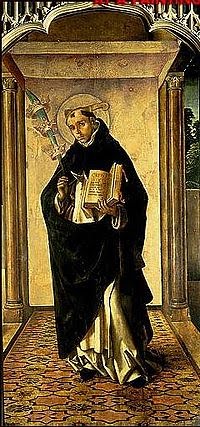
10 JUNE 2010. Today the Dominican Order celebrates the feast day (optional memorial) of Blessed John Dominic, a fourteenth century friar and bishop.

Although John had little education and suffered from a speech impediment that caused him to stammer and stutter, he possessed a tremendous drive to improve himself, overcome his obstacles, and serve our Lord. He also had a great memory, and later in life became a great theologian and preacher.

Born in A.D. 1365 at Florence, Italy, Blessed John spent a great deal of his youth in or around the Dominican church of Santa Maria Novella. He joined the Order at the age of 17 despite his lack of education and hi speech impediment, even while the Dominicans are scholars and preachers.

After entering the Order, Blessed John studied in Pisa and Florence and received a degree from the University of Paris. As a priest, Blessed John once believed that his speech impediment would threaten his vocation, but it was cured through the intervention of Saint Catherine of Siena. Blessed John spent 12 years in Venice as a preacher.


In A.D. 1392, Blessed John found himself to be the Vicar provincial serving in Rome. At the time, Blessed Raymond of Capua was the Master General of the Order, and he helped rebuild the Order after the ravages of the Plague and helped return regular discipline to the Order's members.


Blessed John founded Dominican convents in Venice (A.D. 1388 and A.D. 1394), Fiesole (A.D. 1406), Chioggia, Citta de Castello, Cortona, Lucca, and Fabriano, and was a correspondent of Blessed Clara Gambacorta, advising her of how to restore discipline to Dominican nuns of the day. For a time Blessed John lost papal support because of support for the Dominican White Penitents in Venice, but was later welcomed back and resumed his work in the Order.

Most importantly, Blessed John worked to provide a Christian education to young people. He opposed pagan ideas that were taking hold in the humanism of his day and was a confessor and advisor to Pope Gregory XII.

Blessed John was made Cardinal of San Sisto in A.D. 1407 and Archbishop of Ragusa in A.D. 1408. In these roles, he helped to heal the Western Schism and convinced Pope Gregory XII to call the Council of Constance, and to abdicate the papacy causing the anti-popes to also drop their claims to the papal throne.

Papal legate to Hungary and Bohemia for Pope Martin V, Blessed John worked to settle the disputes caused by the death of Jon Hus and to heal the Hussite Schism. However, while Blessed John was able to convert some, he was unable to to resolve the Hussite Schism.

Blessed John is known today for his scripture commentaries and hymns. His portrait was painted by Fra Angelico, who joined the Order under him, and a memoir of him was written by Saint Antonius of Florence, who joined the Order after hearing Blessed John preach.

Blessed John died on 10 June 1419 at Buda, India. His cultus was confirmed in A.D. 1832 and he was beatified by Pope Gregory XVI in A.D. 1837.

Prayer

O God,
the bestower of divine love,
who didst strengthen Blessed John, Thy confessor and bishop,
for the work of preserving the Unity of the Church
and establishing regular discipline;
grant, through his intercession, 
that we may all be of one mind
and do all our actions in Christ Jesus our Lord.
Who liveth and reigneth with Thee
world without end.


Amen.

09 June 2010

Prayer of Self-Dedication to Christ

Take, Lord, and receive all my liberty, my memory, my understanding, and my entire will, all that I have and possess. You have given all to me; to You, O Lord, now I return it; all is Yours, dispose of me wholly according to Your Will. Give me only Your love and Your grace, for this is enough for me.

Amen.

08 June 2010

Blessed Diana and Blessed Cecilia

Merciful Lord, thank you for the goodness and blessing of cloistered nuns who bear the weight of the world, in prayer for all.

8 JUNE 2010. Today we celebrate the feast day (optional memorial) of Blessed Diana Andalo and Blessed Cecilia, nuns and virgins.

Blessed Diana and Blessed Cecilia were among the very first women to follow Saint Dominic and were among the first members of the Dominican convent in Bologna. Asa they followed Saint Dominic to a life of holiness, today many Dominican and other nuns around the world follow spiritual leaders in examples of holiness, and by their witness teach us holiness.

Pray for cloistered nuns, who are continually praying for the world: pouring themselves out for the world following the model of Christ who emptied Himself for us.

06 June 2010

The Dominican Rosary

-->
The Dominican family follows the medieval custom of beginning the Rosary like the Office of the Blessed Virgin Mary—for the Rosary is known as Mary’s prayer.

Let us pray.
In the Name of the Father, and of the Son, 
and of the Holy Spirit,
Amen.

V.  Hail Mary, full of grace, the Lord is with thee.
R.  Blessed art though amongst women and
     blessed is the fruit of thy womb, Jesus.

V.  Lord, open my lips. +
R.  And my mouth will proclaim your praise.

V.  God come to my assistance.
R.  Lord make haste to help me.

V.  Glory to the Father, and to the Son, and to the Holy Spirit,
R.  As it was in the beginning, is now, and will be forever. Amen.
(Alleluia.) (Praise be to Thee, O Lord, King of everlasting glory.)

Now begin the mysteries of the day. Start each decade by announcing the mystery and directing your imagination and attention towards that particular episode in the life of Christ or Our Lady.

It can be useful to follow the announcement of the mystery with the reading of a related scriptural passage, as indicated below. In this way, the Rosary is not merely a matter of recalling information, but of allowing God to speak to us directly through his word.

Ideally this should be followed be a period of silence, in which to reflect upon the scripture passage before moving on to vocal prayer.

Then, proceed to the recitation of the decade. On the large bead say the Our Father. On each of the ten small beads, say a Hail Mary. (Optionally, the appropriate intercessory prayer, provided below, can be added after each Hail Mary, asking for the assistance one of the Dominican members of the communion of Saints to carry our prayers to Mary, our Mother.) Then pray the Glory Be.

Each decade is a contemplation of the life of Our Lord, witnessed by Mary—one aspect of the paschal mystery. In recognition of the connection with Christian life, we should conclude our contemplation of each decade with a prayer for the fruits specific to that particular mystery. Alternatively, a more general prayer may be said according to custom, such as the following:

O my Jesus, forgive us our sins, save us from the fires of hell, draw all souls to heaven, especially those who are in most need of your mercy.

Or:
Mary, mother of grace, mother of mercy, shield me from the enemy and receive me at the hour of my death. Amen.

Mysteries of the Rosary

Joyful 
Mondays and Saturdays
1.     The Annunciation (Lk 1, 26-38)
2.     The Visitation (Lk 1, 39-56)
3.     The Nativity (Lk 2, 1-20)
4.     The Presentation (Lk 2, 22-28)
5.     The Finding of Jesus in the Temple (Lk 2, 41-52)

Sorrowful
Tuesdays and Fridays
1.     The Agony in the Garden (Mt 26, 36-56)
2.     The Scourging at the Pillar (Is 53, 1-12 / Mk 15, 1-15)
3.     The Crowning with Thorns (Mk 15, 16-20 / Mt 27, 27-31)
4.     The Carrying of the Cross (Lk 23, 26-32 / Mk 10, 17-21)
5.     The Crucifixion (Jn 19, 17-30 / Mt 27, 35-56)

Glorious 
Wednesdays and Sundays
1.     The Resurrection (Mt 28, 1-15 / Lk 24, 1-49 / Mk 16, 1-18)
2.     The Ascension (Acts 1, 3-11)
3.     The Descent of the Holy Spirit (Acts 2, 1-21)
4.     The Assumption (Rev 12, 1)
5.     The Coronation of the Blessed Mother in Heaven (Lk 1, 46-55)

Luminous (Mysteries of Light) 
Thursdays
1.     The Baptism of Christ in the Jordan (Mt 3, 13-17 / Mk 1, 4-11)
2.     The Manifestation of Christ at the wedding of Cana (Jn 2, 1-11)
3.     The Proclamation of the Kingdom of God, with his call to conversion (Mt 4, 12-25 / Mk 1, 15 and 2, 3-13 / Lk 7, 47-48 / Jn 20, 22-23)
4.     The Transfiguration (Mt 17, 1-9 / Lk 9, 28-36)
5.     The Institutionalization of the Holy Eucharist (Lk 22, 14-20 / Jn 13, 1)

OPTIONAL INTERCESSORY PRAYERS
(by Jean Jeandron DeCuir)
-->
First Decade: We ask Saint Dominic to carry our prayers to Mary, our Mother.
1.     Father Dominic, founder of this family of spiritual brothers and sisters praying before you, pray for us.
2.     Father Dominic, beloved son of Blessed Joan of Asa and brother to Blessed Anthony, pray for us.
3.     Father Dominic, passionate son of the Virgin Mary, pray for us.
4.     Father Dominic, devoted instrument of Mary in promoting her Holy Rosary, pray for us.
5.     Father Dominic, unflinching apostle in your apostolic and mission of preaching, pray for us.
6.     Father Dominic, mediator of Mother Church in battle against the heresies of your time, pray for us.
7.     Father Dominic, unselfish defender and brother to the poor and humble, pray for us.
8.     Father Dominic, guileless instrument of God's many miracles, pray for us.
9.     Father Dominic, contemporary and spiritual brother of Saint Francis of Assisi, pray  for us.
  1. Father Dominic, incorrupt model in body and spirit, in life and death, pray for us.

Second Decade: We ask Saint Catherine of Siena to carry our prayers to Mary, our Mother.
1.     Sister Catherine, our spiritual sister in the charism of Dominic, pray for us.
2.     Sister Catherine, virgin, mystic, and visionary, pray for us.
3.     Sister Catherine, gifted daughter of Christ with whom you shared your heart, pray for us.
4.     Sister Catherine, joyful embracer of the stigmata of our Lord, pray for us.
5.     Sister Catherine, nurse to those stricken by plagues, leprosy, and cancer, pray for us.
6.     Sister Catherine, minister to condemned prisoners, pray for us.
7.     Sister Catherine, spiritual daughter of your confessor, Blessed Raymond of Capua, pray for us.
8.     Sister Catherine, peacemaker, prophet, and Doctor of the Church, pray for us.
9.     Sister Catherine, tireless supporter of the Roman papacy against it enemies in the Great Schism, pray for us.
10. Sister Catherine, faithful recorder of our Lord's intimate conversations with you in the Dialogue, pray for us.

Third Decade: We ask Saint Martin de Porres to carry our prayers to Mary, our Mother.
1.     Brother Martin, our spiritual brother in Dominic, pray for us.
2.     Brother Martin, patron saint of interracial justice, pray for us.
3.     Brother Martin, child of humble birth and giant among saints,  pray for us.
4.     Brother Martin, contemporary and friend of Saint Rose of Lima, pray for us.
5.     Brother Martin, humble instrument of God's supernatural gifts and miracles, pray for us.
6.     Brother Martin, caretaker of the poor, the orphaned, and the African slaves, pray for us.
7.     Brother Martin, lover and protector of all of God's creatures, great and small, pray for us.
8.     Brother Martin, possessor of spiritual wisdom beyond all limits, pray for us.
9.     Brother Martin, model of deep, personal penance, pray for us.
10. Brother Martin, champion of the humble, pray for us.

Fourth Decade: We ask Saint Rose of Lima to take our prayers to Mary, our Mother.
1.     Sister Rose, virgin, mystic, and visionary, pray for us.
2.     Sister Rose, humble, recluse and devoted daughter, pray for us.
3.     Sister Rose, secret sufferer of your great beauty, pray for us.
4.     Sister Rose, spiritual sister of Saint Catherine of Siena, pray for us.
5.     Sister Rose, holy instrument against the earth's fury, pray for us.
6.     Sister Rose, spiritual sister of your contemporary, Saint Martin de Porres, pray for us.
7.     Sister Rose, survivor of temptations, loneliness, and sadness, pray for us.
8.     Sister Rose, beloved daughter of God, author of countless miracles, pray for us.
9.     Sister Rose, patroness of Latin America and the Philippines, pray for us.
10. Sister Rose, first American to be canonized by Mother Church, pray for us.

Fifth Decade: We ask Saint Thomas Aquinas to take our prayers to Mary, our Mother.
1.     Brother Thomas, most scholastic son of Father Dominic, pray for us.
2.     Brother Thomas, holy priest and Doctor of the Church, pray for us.
3.     Brother Thomas, chaste servant and "Angelic Doctor," pray for us.
4.     Brother Thomas, humble master of theological and philosophical studies, pray for us.
5.     Brother Thomas, greatest theological master of Christianity, pray for us.
6.     Brother Thomas, servant of God, gifted with visions, ecstasies, and revelations, pray for us.
7.     Brother Thomas, scholar who opened our natural reasoning to discover God, pray for us.
8.     Brother Thomas, fruitful preacher of the Word, who declined all offers of priestly promotions, pray for us.
9.     Brother Thomas, author of the great Summa Theologica, pray for us.
10. Brother Thomas, patron of all universities, colleges, and schools, pray for us.

Conclusion of the Holy Rosary
Hail, holy queen, Mother of mercy,
hail our life, our sweetness, and our hope.
To thee do we cry,
poor banished children of Eve.
To thee do we send up our sighs
mourning and weeping in this vale of tears.
Turn then, most gracious advocate,
thine eyes of mercy toward us,
and after this our exile
show unto us the blessed fruit of thy womb, Jesus.
O clement, O loving,
O sweet virgin Mary.

V.  Queen of the Most Holy Rosary, pray for us.
R.  That we may be made worthy of the promises of Christ.

Let us pray.— O God, whose only-begotten Son, by His life, death and resurrection, has purchased for us the rewards of eternal life; grant we beseech thee, that meditating upon these mysteries of the Most Holy Rosary of the Blessed Virgin Mary, we may imitate what they contain, and obtain what they promise, through the same Christ our Lord.
R.  Amen.

V.  May the divine + assistance remain always with us.
R.  Amen.

V.  May the souls of the faithful departed, through the mercy of God, rest in peace.
R.  Amen.

V. May the blessing of Almighty God, Father, Son and Holy Spirit descend upon us and remain with us always.
R.  Amen.

There is also a custom of ending the Rosary with prayers for the intentions of the holy Father, the whole Church, the (arch)bishop of the diocese, and the holy souls in purgatory. The following prayers are suggested:

For the Intentions of the Pope and the needs of the Church and of the nation:

Our Father. Hail Mary. Glory Be.

For the (arch)bishop of this diocese and his intentions:

Our Father. Hail Mary. Glory Be.

For the Holy Souls in Purgatory:

Our Father. Hail Mary. May they rest in peace.

Eternal rest grant unto them, O Lord,
And let perpetual light shine upon them.
And may the souls of the faithful departed, through the mercy of God, rest in peace.

R.  Amen.

In the Name of the Father, and of the Son, 
and of the Holy Spirit,
Amen.

04 June 2010

et alia

4 JUNE 2010. This Spring has been a wonderfully busy and challenging time for our family and those we know and love. In recent days there have been sad events, but the hope of Christ continues to shine through the news that could otherwise lead to dispair.

Running on at the keyboard . . . .

A little more than a month ago, the husband of one of my wife's close friends committed suicide. He left a beautiful wife and family--three children under the age of 10. I pray that God comforts him in eternal peace and grants him generously the gift of His love, looking not on his acts in judgment, but with a Sacred Heart of compassion for what his poor soul must have endured to make suicide appear to be his only remaining option.

The Tallahassee Lay Dominican inquiry group continues to grow in devotion to our Lord as a community. I and my six fellow group members have completed the inquiry phase and wait anxiously for the next phase of candidacy to be approved by the Southern Province.

We hear news everyday that tar balls and the omnipresent oil slick is moving closer to coming ashore in Florida. Tallahassee is about an hour or so, due north, from the coast. The beaches in the panhandle of Florida are some of the most beautiful in the world, and it will be a terrible shame to see them desecrated with crude oil. However, our plight will likely be much less serious that the poor folks affected by the Deepwater Horizon disaster in Louisiana, Mississippi, and Alabama. I pray that all of those contributing to end this ongoing catastrophe will be guided by God's grace and will successfully and quickly bring the flow of oil into the beautiful Gulf of Mexico to a halt.

One of the deacons at our local parish suffered a very serious head injury over the Memorial Day weekend and is in very serious condition, in ICU, at our local hospital. I understand that our Bishop paid him a visit yesterday and although he is only in a state of semi-consciousness, he seems to have some awareness of visitors. I thank Bishop Ricard for his caring and loving pastoral approach. Please join our parish family in praying for Deacon Marcus and his family.

Another of my wife's dear friends has suffered two tragedies in the past weeks. Her husband became very ill  and was rushed to the hospital, only to learn that he is severely diabetic and was suffering from acute pancreatitus. Now having been hospitalized for more than two weeks (much of that time in ICU), he is starting to show signs of improvement. But, last Sunday morning--Trinity Sunday--his mother-in-law (my wife's girlfriend's mother) had a severe stroke and died. The funeral is tomorrow, while our friend still remains in the hospital. Please pray for abundant grace to be showered upon this family and for the repose of the soul of a mother and grandmother who will be dearly missed.

On a joyous note, this Sunday our parish will host the first mass of Father Kevin McQuone, who will be ordained here in Tallahassee at the Co-Cathederal of Saint Thomas More tomorrow. Our diocese has been richly blessed by many ordinations of vibrant and faithful young men to the priesthood in recent years. In this Year for Priests especially--but, at any time and at all times--please pray for our priests.

I also pray for a peaceful resolution to the most recent conflict crisis in the Middle East.

On behalf of faithful Catholics from our diocese and all of Florida, and others of good will who may follow these pages, we offer Archbishop Wenski, installed as Archbishop of Miami on 1 June, a heartfelt and joyous welcome as our metropolitan archbishop. And, to now-retired Archbishop Favalora, a very gracious and warm "Thank you" for many years of his faithful and good service to all the faithful in Florida.

And, for followers of these pages in Florida (or elsewhere), please make sure to let Governor Charlie Crist know of your support of HB 1143 (the law passed by the Legislature this session requiring pre-abortion sonograms and preventing government money from being used to pay for abortions under the Obama Administration's recent health care overhaul law). Governor Crist has not yet vetoed or signed HB 1143 into law. He has the option of signing the bill or allowing the bill to become law without his signature. The scuttle here in Tallahassee is that he is leaning towards a veto, but I believe he can swayed if the silent majority of Floridians make their preference for life known to the Governor. The Florida Catholic Conference provides an easy way to make your wishes know to the Governor here.

To carry the previous point a bit farther . . . politically, it makes no sense for Governor Crist to veto HB 1143. If he did so, he would make the extreme left happy, but they are not going to vote for him in the upcoming general election anyway. On the other hand, if HB 1143 becomes law (by the Governor's signature or otherwise) those who were originally swayed to vote for him as the Republican candidate for governor four years ago may still see a principled man running for the U.S. Senate. (All lawyers in Tallahassee handicap statewide politics unfolding here, at least on a part-time basis.) In my novice political view, a veto stands no chance of gaining additional votes, but runs the real danger of further eroding Charlie's mainstream and conservative leaning support. It would be for me, personally, the death knell of my consideration to support him.

I pray that God will bless and keep all who find these pages.

Saint Peter of Verona

4 JUNE 2010. Today the the Dominican Order celebrates the memorial of Saint Peter of Verona, a thirteenth century friar, priest, and martyr.

Peter was born in Verona, Italy in A.D. 1205, and later attended the University of Bologna, where tradition records that he maintained his orthodoxy in the faith and met Saint Dominic at the age of 15. Afterwards, Saint Peter joined the Order and became a noted preacher in Northern and Central Italy.

From the decade of A.D. 1230 onward, Saint Peter preached against heresy in Italy. In A.D. 1234, Pope Gregory IX appointed Saint Peter as the inquisitor for Northern Italy. In that role, it is said that Saint Peter evangelized the whole of Italy, preaching in Rome, Florence, Bologna, Genoa, and Como.

In A.D. 1251, in recognition of Saint Peter's strict adherence, austere lifestyle, and zeal for teaching, Pope Innocent IV appointed Peter the inquisitor of Lombardy. Although history does not record much in the way of official acts of Saint Peter in this role, there is one recorded declaration of clemency issued for those confessing heresy or sympathy for heresy.

Because Saint Peter preached effectively against heresy, a group of Cathars plotted to kill him, and hired an assasin--Carino of Balsamo--to accomplish the murderous task. On 6 April 1252, while Saint Peter was returning to Milan from Como along with another friar, Dominic, the assasin attacked the pair on a lonely spot near Barlassina, cutting off the top of Saint Peter's head with an ax and mortally wounding Friar Dominic. Saint Peter was killed in the attack and Friar Dominic died five days later in Meda, but history records that Saint Peter began reciting the Apostle's Creed as he was attacked, dying with a prayer on his lips.

Saint Peter's body was carried to Milan and laid in an ornate mausoleum in the Church of Sant'Eustorgio, where many miracles have been attributed to him at his tomb.

Pope Innocent IV canonized Saint Peter on 25 March 1253, less than a year after his martyrdom, making Saint Peter of Verona the fastest papally canonized saint in the history of the Church.

post scriptum.--Carino of Balsamo, killer of Saint Peter, later confessed his crime and converted from heresy to the true faith. He was eventually accepted into the Dominican Order as a lay brother at the convent of Forli.

Prayer

Grant we beseech Thee, 
O Almighty God, that with fitting devotion 
we may follow the faith of blessed Peter, 
Thy martyr, 
who in the spreading of that same faith, 
was found worthy to win the palm of martyrdom. 
Through our Lord Jesus Christ, Thy Son, 
Who liveth and reigneth with Thee in the unity of the Holy Ghost, 
world without end. 

Amen.

02 June 2010

Blessed Sadoc and Companions

2 JUNE 2010. Today we celebrate the feast day (optional memorial) of Blessed Sadoc,a friar and priest who, with his companions, was martyred in A.D. 1260.

Blessed Sadoc studied at the University of Bologna, Italy. He was a Dominican friar who received the habit from Saint Dominic de Guzman himself. At the General Chapter the Dominicans in Bologna in A.D. 1221, Blessed Sadoc was chosen to assist Master Paul of Hungary to establish a province in Hungary. Later, Blessed Sadoc moved  to Poland where he served as preacher for nearly forty years. In A.D. 1260, Blessed Sadoc and his eight Dominican companions from Sandomierz were martyred by the Tartars as they were singing the Salve Regina at Compline. Hence, today Dominicans have a custom of signing the Salve Regina at the deathbed of members of the Order.

Prayer

Lord Jesus,
in the midst of fierce attacks of the foe
Blessed Sadoc and his companions
greeted the Virgin Mary in song 
and received the longed-for palm of martyrdom. 
After this exile may your merciful and loving Mother
show us to you, 
who live and reign in the unity of the Holy Spirit, 
one God, for ever and ever.

Amen.